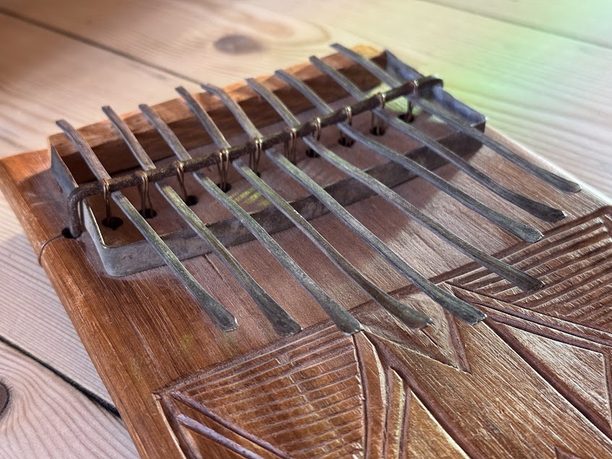
A thumb piano is an old and simple thing. A row of metal tines over a wooden box, plucked by hand. Each tine is one note, and its length sets the pitch. It sounds like a music box that someone is playing by hand, which is pretty much what it is.
Its ancestor is the mbira of the Shona people of Zimbabwe, and there it’s far more than a sound. Its most important role is as a “telephone to the spirits”, played through the night at ceremonies called bira to reach family ancestors and much older guardians. About a year after someone dies, at a ceremony called kurova guva, the mbira welcomes their spirit back to the community.
An instrument for calling across time. I’ve had it for so long I can’t remember when it entered my life, or where it’s from. It feels like it was always meant to be here.
It’s had some knocks and scrapes and the songs it sings today are different to what they once were. But it’s found the notes that are right for right now. Two of its tines are out, the A♯ a little sharp and the C♯ a little flat. But that happens to us all. Those things that aren’t quite right are what make us unique.
Over the years, many songs have been lost and found, they have each had their time on its tines. There is one that often finds my fingers. It’s remembered many times as audio memos, between recordings of train journeys and windy walks. Just a few notes, F♯ and A♯ rocking back and forth with a B or a G♯ underneath.
The same two notes mean different things depending on what lies beneath them. Over B they sound hopeful, a warm B major 7. Over G♯ they turn wistful, a G♯ minor 9. Nothing in the melody changes. Only the ground it stands on.
One memory, two meanings. The bass decides how it feels.
In some memos Finch and Hazel hum along at bedtime. The thumb piano keeps its pattern, steady as a clock. Their voices don’t. They meander across the notes and between them, finding places the tines can’t reach.
The tines have their order, a predetermined pattern. But the beauty is in those moments that felt spontaneous, where the voice finds its own way. That’s the whole of Fractured Flight, the film I’ve been making for some years, in a moment before bedtime.
The Bones?
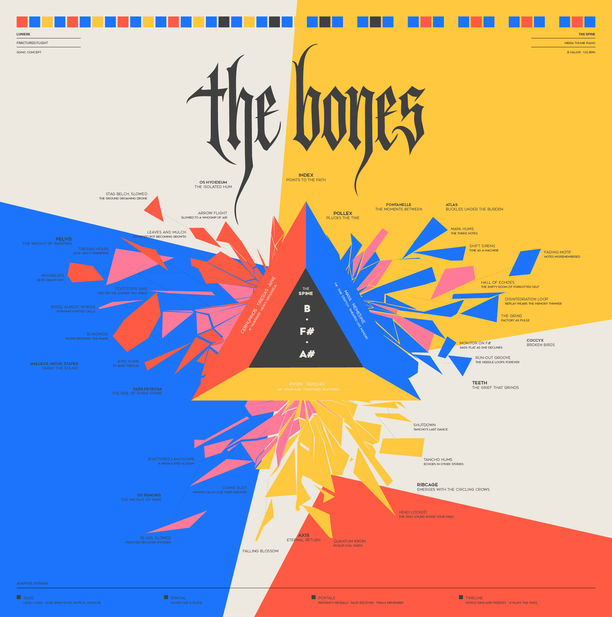
It sometimes helps me to assign character and systems to abstract ideas. Finding that character requires work. You have to dig deep into the mulch before finding it. At first I felt teeth, still strong on a wooden jaw. Teeth; those things that crack in time, that fall out and are kept like memories of what once was. Somehow, bones began to connect everything together.
The mbira is now the bones of the score, the scaffolding that holds everything together. Its spine is three notes, one for each of Fractured Flight’s three storylines.
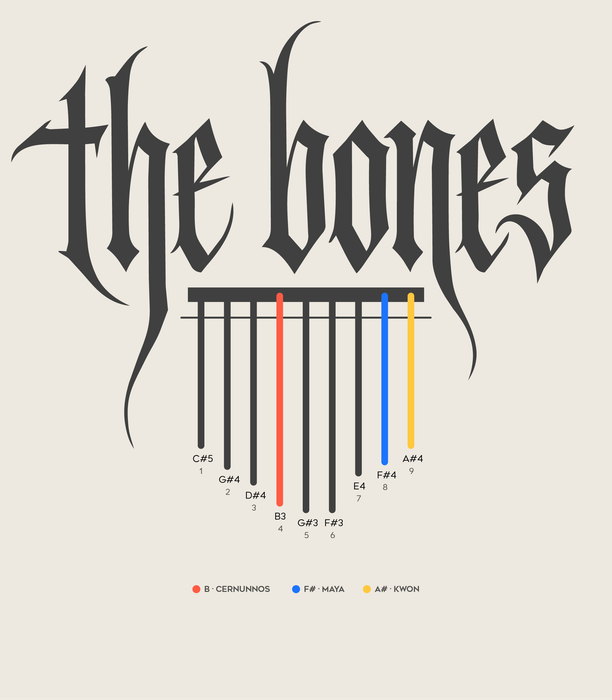
B: Cernunnos and the ancient time. The root. The ground everything else stands on.
F♯: Maya and Nemesine. It’s tuned into the beeping monitor in Maya’s room. Real pulse oximeters lower their pitch as oxygen falls, so her F♯ may slowly sag flat. As her dementia progresses, her motif will misremember itself, notes dropping out or arriving in the wrong order.
A♯: Kwon and Tancho. In B major it’s the leading note, the one that pulls back home to B. Kwon’s era wants to resolve to the beginning. The tension in the music is the loop itself.
“Life can only be understood backwards; but it must be lived forwards.”
Søren Kierkegaard
The score is starting to grow a skeleton. If the three notes are the spine, everything else needs connecting back to that. A working map:
Teeth: the grief that grinds. A relentless clatter of notes on the tines.
Jaw: the grind. Nemesine’s factory: sorters, conveyors, a relentless pulse.
Ribcage: Kwon and Tancho hide inside. A soft and quiet togetherness, protection against the circling crows.
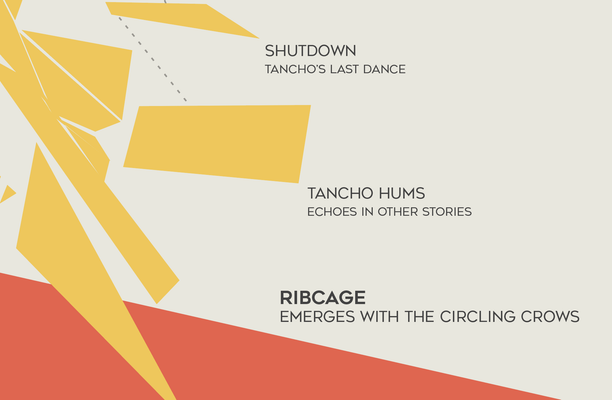
Pelvis: the bass. The bowl at the bottom that carries the weight, and decides how everything above it feels.
Marrow: sounds grown from inside the bones. Granular textures made from the mbira samples themselves.
Then there are the smaller bones, with exotic names.
Pollex and index, the thumb and the pointing finger, are how an mbira is played. Thumbs pluck; the index flicks.
Os hyoideum, the hyoid, anchors the tongue and is the only bone that doesn’t touch another. It floats. It belongs to the hums. Its name means shaped like the Greek letter upsilon, the ancestor of our Y. The Romans called Y the Pythagorean letter: a path that forks in two, a choice. A floating, forked bone in the throat, holding the voice that is free to choose.
Malleus, incus, stapes: the hammer, anvil and stirrup. Three tiny bones passing sound inward, nearly full size at birth. Three notes, passed through time, heard by a baby.
Pars petrosa, the stony part. Often called the densest bone in the body, and it houses the inner ear. The hardest bone, holding our hearing, is named after rock.
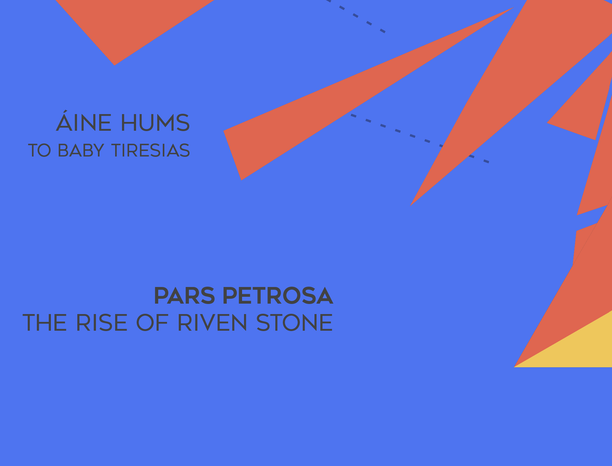
Os femoris, the femur. The longest and strongest, for the heaviest moment of all: the weight of war.
Atlas holds up the skull, named for the Titan who held up the sky. Axis, just beneath it, lets the head turn. With a timeline shaped like a helix, Axis is the eternal return: portal after portal, turning back.
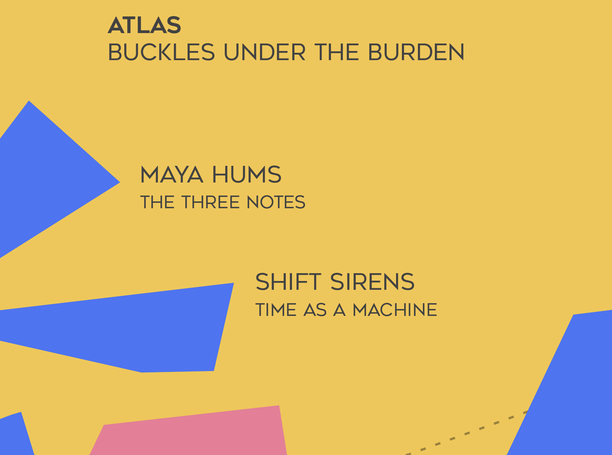
Coccyx, from the Greek for cuckoo. A vestige of a tail, left over from a much older time. Birds are an important motif throughout the story: the crows, the crane, the black feather. On the map, the coccyx is the broken birds.
Os lunatum, a wrist bone shaped like a crescent moon. That one’s just for me.
Fontanelle, the soft gaps in a baby’s skull before the bones join. The word means little fountain. Maybe that’s the silence, the places between stories.
In the film, the three notes travel by voice. Maya hums them. Tiresias hears them through a portal. Áine hums them to baby Tiresias. Tancho hums them whilst dancing under her own scattered ashes.
So who hummed them first? Nobody. The melody exists only because it was passed on, a loop with no beginning. A bootstrap paradox, small enough to hum.
There’s a line on the story board I keep coming back to: “past present future. Nothing can change what was always meant to be.”
“All moments, past, present and future, always have existed, always will exist.”
Kurt Vonnegut, Slaughterhouse-Five
Next, I’ll sample each tine, write a bass line under the spine, and find out what three notes sound like through a portal.
For now it’s a few notes, played at home, with the kids humming along. I’m still not sure who hummed it first.
A skeleton decides the shape of everything that grows around it: where the weight sits, how it moves, which way it turns its head. These bones are still loose on the table, a few notes and a couple of hums, but they’re beginning to fit together. Something strange and beautiful is starting to take form. I don’t know yet what it will look like when it stands up.
Leave a comment