Maya Through the Looking Glass

In through the window,
an old lady looking out.
A quiet between.
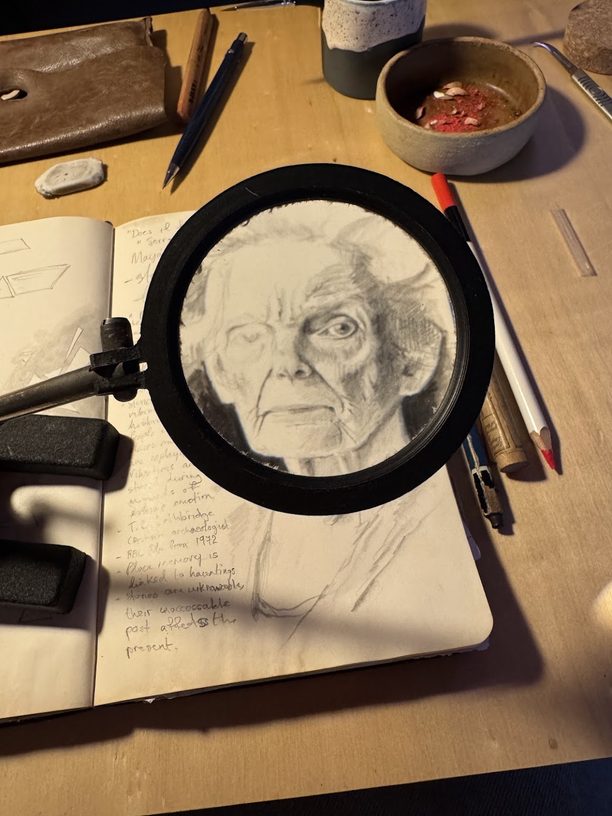
A large black magnifying glass rests over an open sketchbook, isolating a graphite drawing of an elderly woman's face by Aaron Bradbury. Her expression is intense and weathered. The lens crops the image into a stark circle, while the surrounding page shows blurred handwritten notes about "Stone Tape Theory" and memory. Drawing tools, including pencils and erasers, are scattered across the wooden desk.

A diagnostic screen capture of Maya’s consciousness. 
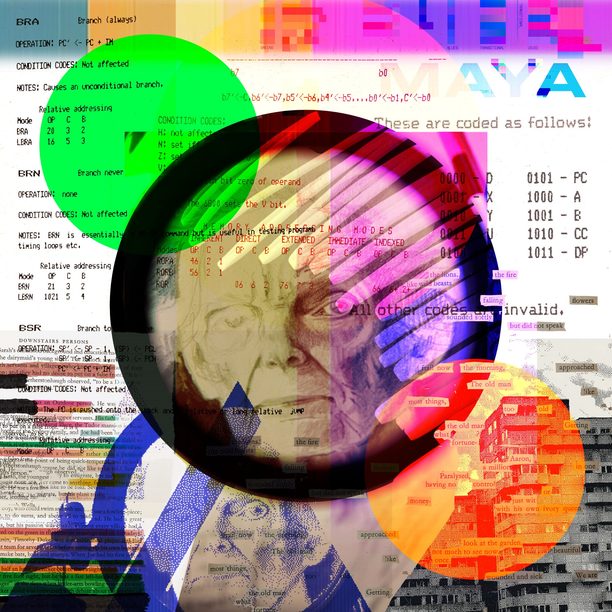
A high-contrast graphic collage featuring Motorola 6800 assembly code documentation overlaid with vibrant neon Y2K vector curves, cyan typography reading "MAYA", and a central circular lens showing a detailed graphite sketch of a woman's face. Cutout text snippets with phrases like "Paralysed, having no control" and "All other codes are invalid" are scattered across intense orange, green, and pink color blocks.

The Assembly Code Framework (⁠BRA⁠ vs ⁠BRN⁠): Motorola 6800 assembly code. The commands BRA⁠ (Branch Always) and ⁠BRN⁠ (Branch Never) strip the existential illusion, a quiet insult to free will.

All other codes are invalid.

At the intersection of the optic vector, she surfaces as an anomaly pinned inside an address space. Residual human memories bleed through low-level firmware: paralysed, frail, wounded and sick.

A century of recording substrates flattened onto a single glass plane: 19th-century printed prose, mid-century graphite sketch, 1970s microchip assembly manuals, 1980s neon punch, 1990s kinetic vector UI, 2000s apartment block.
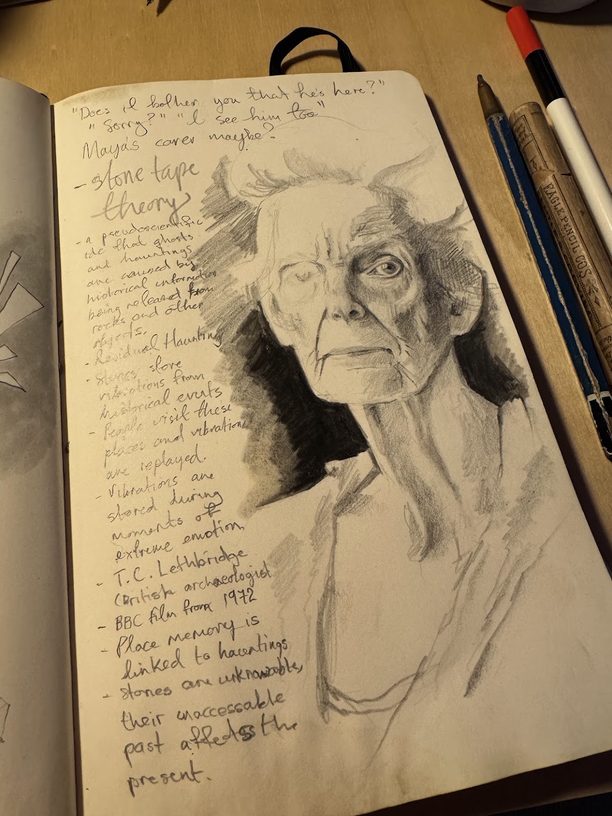
A top-down view of an open sketchbook revealing the complete graphite drawing of the elderly woman by Aaron Bradbury. Heavy, dark shading contrasts with the lighter rendering of her face and torso, giving a sense of fading or unraveling. The left margin is filled with handwritten cursive notes discussing "Stone Tape Theory," residual hauntings, and the idea that stones store vibrations from moments of extreme emotion. Colored markers and pencils rest on the wooden surface beside the book.

Stone Tape Theory made visible: memory is never deleted, only overwritten on the same substrate again and again until the layers begin to hum. Pulling back through the lens reveals the paper, the pencil dust, and the silence of the room where the signal was caught.

The grandfather clock
tells the rain to never stop.
The bone finger knocks.

Leave a comment

Your email address will not be published. Required fields are marked *

This site uses Akismet to reduce spam. Learn how your comment data is processed.