If I could go back to any point in time and space to experience any moment of history of my choosing… Other than Pat Sharpe’s ‘Fun House‘, I would go and see the Vortex Concerts at the Morrison Planetarium in California 1959.

The Vortex Concerts were described by Junius Adams as “Entertainment for the Space Age”. It was perhaps the first of its kind, a dome based audio visual 360 degree immersive environment. It made audiences feel “engulfed and overwhelmed by the patterns of sound and light”.
The Vortex IV program notes stated:
Vortex is a new form of theater based on the combination of electronics, optics and architecture. Its purpose is to reach an audience as a pure theater appealing directly to the senses. The elements of Vortex are sound, light, color, and movement in their most comprehensive theatrical expression. These audio-visual combinations are presented in a circular, domed theater equipped with special projectors and sound systems. In Vortex there is no separation of audience and stage or screen; the entire domed area becomes a living theater of sound and light.
It’s like the roller coaster ride in Cinerama, only in the abstract
One of the lucky spectators comments of the show. Sounds like the description of an acid trip.
Jordan Belson created the visual aspects of the shows. I’m a huge fan of his flat screen work, but I’ve not yet been able to find any imagery from the vortex shows. I can only imaging it would have been similar to his other work, which seems to be dominated by circles and abstract astronomical phenomena.
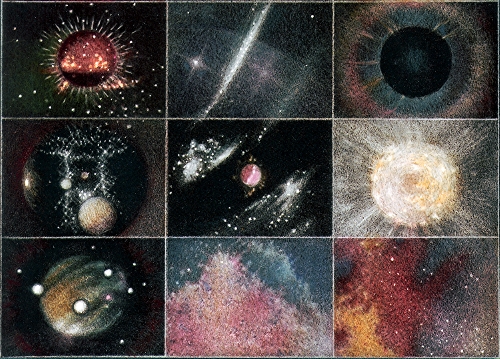
Images from Music of the Spheres artwork, 1977
© Jordan Belson, courtesy Center for Visual Music

Cover, Vortex III program, January 1958
Collection Center for Visual Music
One thing that really stands out to me about the Vortex concerts is the equal emphasis on sound as visual. Audio is something that commonly gets much less attention in many fulldome productions and indeed facilities. The diagram below shows the layout of the audio speaker system during the concerts at the Morrison Planetarium. Each of the white circles represents one speaker station comprised of one bass and two treble speakers, which were arranged in a ring behind the 60ft dome. The audio could be channelled to each or any speaker remotely. There are also two sub-woofers around the perimeter and two subsidiary speakers in the centre of the dome that had a separate sound input.

You can purchase a stereos version of the Vortex Concerts audio from here. To be honest, it’s quite terrifying in places… I can’t imagine what it would have been like to have been bombarded with these sounds and the psychotropic visuals of Jordan Belson… I wish I could have been there.

During the past two IPS Conferences, I have been to see talks from Rene Rodigast from the Fraunhofer institute in Germany. Fraunhofer is a research organisation that has produced some key technologies for the age of digital media, the mp3 codec is one such technology they have been involved in. Well, Rene is one of the audio wizards that works there and his research is genuinely mind blowing. I was really surprised to see him present his work to only a handful of people in a huge lecture theatre at the last IPS in Alexandria. I’ve recently been to Fraunhofer FIRST in Berlin to do some stereoscopic fulldome testing… It really is an incredible place. I met up with a Rene who is working on some immense spatial sound synthesis using multi-speaker arrays. He can literally place a sound anywhere in 3d space in a dome. He also spends time drilling holes in different material dome floors to alleviate the inherent resonance issues caused by projecting sounds in a dome. … I’m losing my point here… I guess I’m fascinated that 40 speaker arrays were used in the 50’s to create immersive sound yet 5.1 surround is still the predominant sound system in digital domes. The visual aspect of fulldome has been developed to such a high degree but the audio development hasn’t really surfaced properly as yet. Maybe there are more places adopting a spatial sound approach, maybe there is a need for creative tools before any such system can be taken advantage of?
Leave a comment