It’s been a while since doing any stereoscopic work but I haven’t really stopped thinking about the language of stereoscopy and using it as a creative tool. Rather than continuing to explore my own ideas I have been delving deeper into the history of stereoscopy and how it has been used before. There are a lot of common misconceptions about stereography, probably the biggest of those is that it hasn’t been around for that long. Stereo photography emerged shortly after the invention of photography in the mid 1800’s.

In 1838 Charles Wheatstone, pictured in the above drawing by Samuel Laurence, invented stereoscopy, the techniques of presenting each eye with a slightly different image to convey depth. Shortly after in 1840, he went on to first describe the way our brains perceived depth by the use of binocular vision.
The medium became fashionable following Queen Victoria’s introduction to the stereoscope at the 1851 Great Exhibition in the Crystal Palace. By the second half of the 19th Century stereoscopy enjoyed its first craze amongst the Victorians when stereograms were actually more commonplace than photographs, although many are now displayed as single photographs.
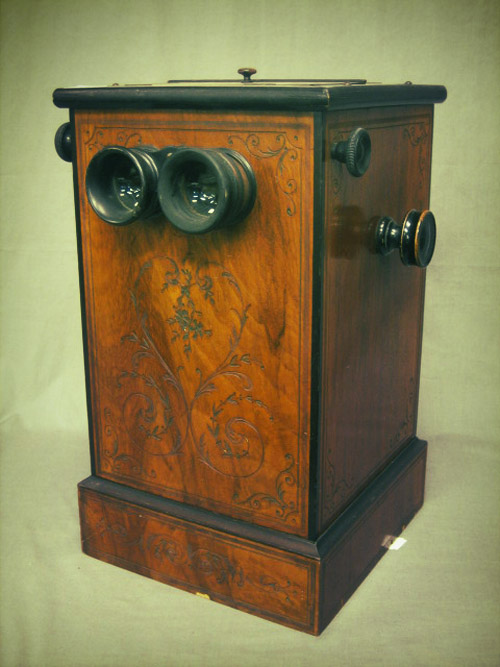
A Victorian era Stereoscope
I recently purchased a book by Brian May and Elena Vidal entitled ‘A Village Lost and Found’. The book contains a large collection of stereoscopic images taken by T. R. Williams around an enigmatic English village in the mid 1800’s. The book comes with a nicely designed flat-pack stereoscope for viewing the images called the OWL (pictured below). Published by The London Stereoscopic Company, it is an incredible insight into one man’s stereoscopic exploration of a small English village, giving a unique perspective on village life and an insight into early stereography.
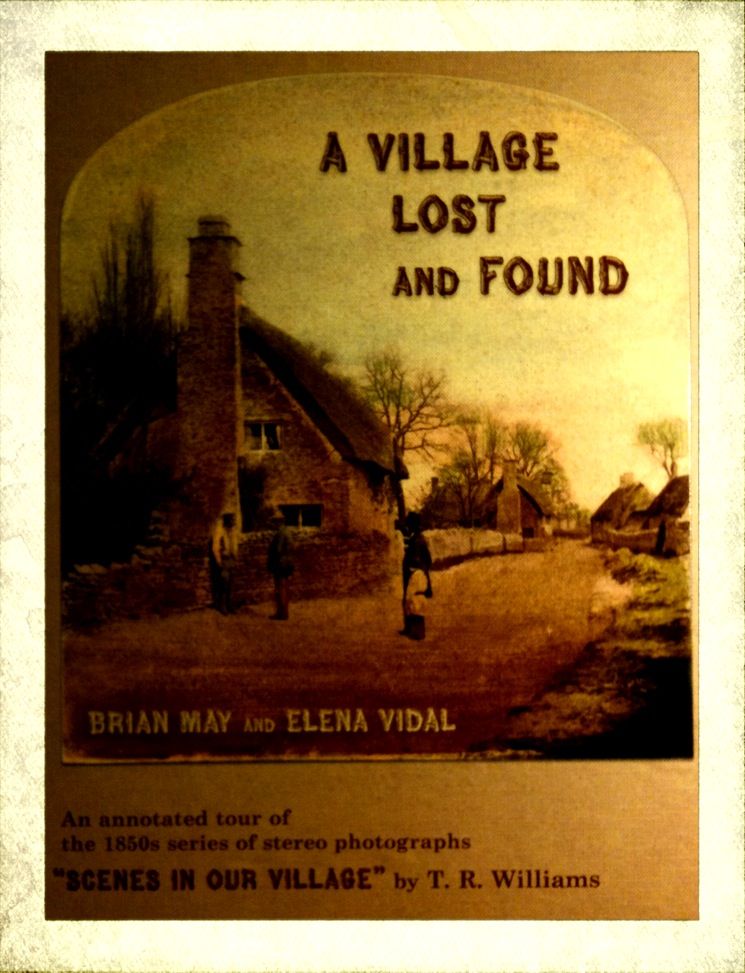
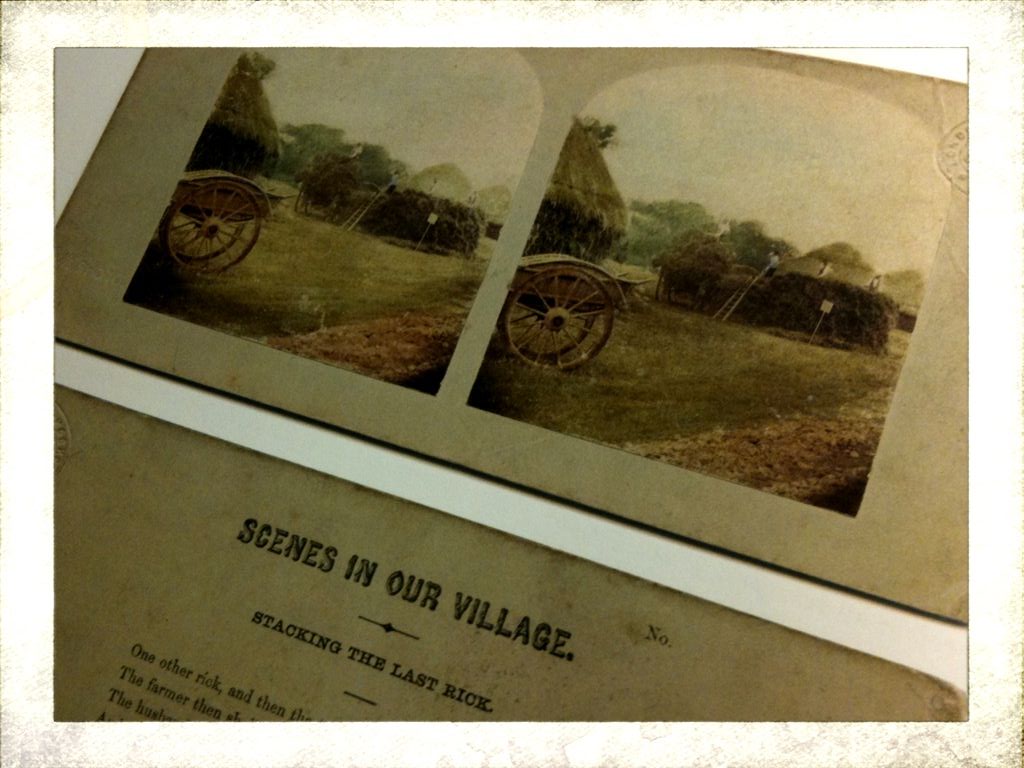
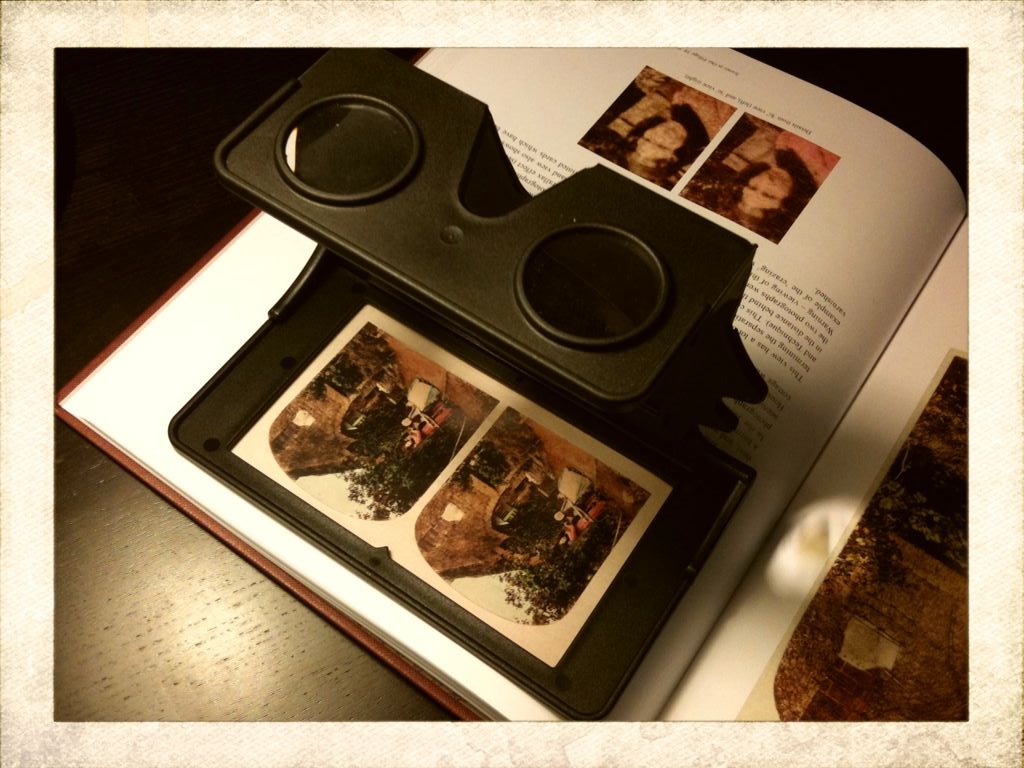
The OWL stereoscope is very easy to use and I’ve found that even people who find it hard to look at a 3d lenticular or use polarised glasses seem to find it very easy to view the images in 3D. Many people are shocked to see stereoscopic images of this age at all and especially surprised by the quality of the photographs. It’s fascinating to see the way the images are composed and how the stereo depth is balanced across the image, like you might balance weighted objects in 2 dimensional image making.
Another thing that has intrigued me recently is towards the end of the film ‘The Assassination of Jesse James’, the narrator mentions a stereoscopic photo of the corpse of Jesse James. This photo was taken in 1842. The quote below suggests it was very popular at the time, although I haven’t been able to find much information about this.

“Another photograph was taken of the renowned American bandit nestled in his bed of ice. And it was this shot that was most available in sundries and apothecaries to be viewed in a stereoscope alongside the sphinx, the Taj Mahal, and the catacombs of Rome.” The Assassination of Jesse James by the Coward Robert Ford (2007)
Now these are really quite special…

These stunning stereo photography of the moon are by Henry Draper, best known for his pioneering astrophotography. His father John Williams Draper, is the man credited with taking the very first astrophotograph.
Taking a stereoscopic image of the Moon is still a technical challenge today. The left and right photos were not taken side by side at the same time, as they are usually. Even if you had cameras on opposite sides of the Earth the perceived distance at that moment would only be around one degree rotation of the Moon. Instead, each photo is taken several months or even years apart at the two peaks of the Moon’s libration during the same phase.

This animation shows how the moon ‘wobbles’ as it circles us around its seemingly fixed pivot.
This is really just a snippet of the early world of stereography and some of the areas I’ve been researching. I’m currently exploring ideas about stereoscopy in storytelling and collecting information from other people also passionate about this medium as an emotional device. Hopefully this will all feed into the nest stereoscopic production and help to produce some meaningful work in s3d.
Leave a comment